Written and Presented by Shannon Cuykendall at Ohio State University November 10, 2026
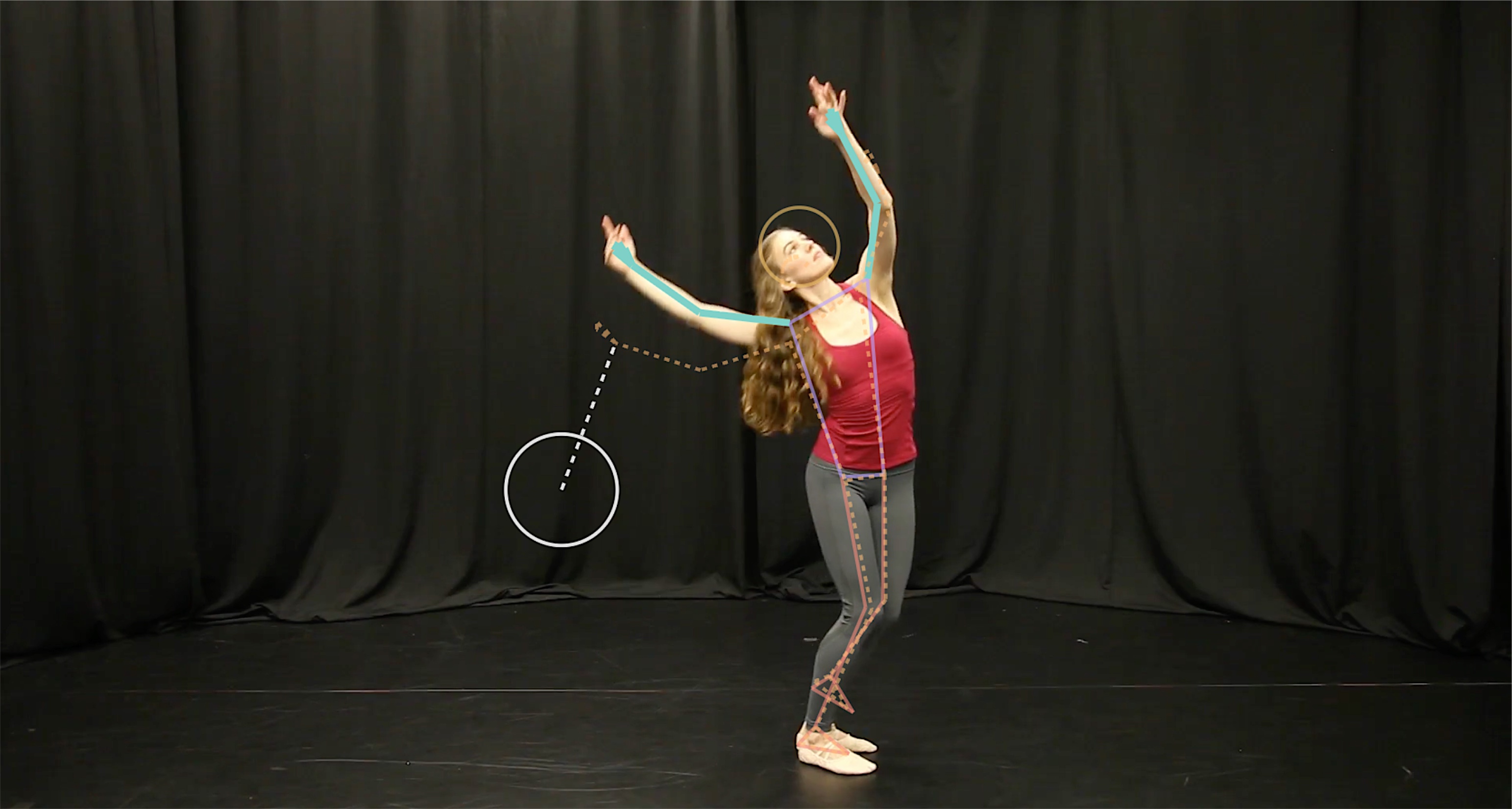
Hi, my name is Shannon Cuykendall and in the book Performance and Technology I write about how technology and specifically the screen impact the way in which we engage with and learn knowledge in dance.
Now the screen is always a contentious topic—as a mother, the phrase “screen time” sparks all types of heated conversations and recommendations. My point of the book chapter is not to make a value judgement but rather to demonstrate how the screen affords a way to interact with dance knowledge that is not always possible in live performances.
I question what ways of interacting with dance knowledge through the screen will continue as the screen becomes increasingly blurred with our physical environment (XR technologies).
One area I did not discuss in the book chapter is how artificial intelligence is changing not only how we interact with dance knowledge but also how we produce dance knowledge. This is the focus of my research now as a SSHRC post doctoral researcher at Simon Fraser University in Canada.
To help you experience some of the research questions I am currently pondering, I would like to invite you all to participate in an activity with me. If you feel comfortable, close your eyes and we are going to check in with our bodies.
Notice the way you are seated in your chair. How is your body adapting to the chair? Maybe you are leaning your back against the chair. What parts of your limbs are touching the chair? What are your elbows doing? What areas of your body have more or less pressure against the chair? Maybe there is a part of your spine that is pressed more fully into the chair. Is any part of your body making contact with another part of your body? Maybe your legs are crossed or your hand is resting on your thigh. What part of your body is making contact with the floor? What are your toes doing?
Take a moment to consider all of these areas of contact and how we feel and experience the world around us. How does the touch feel? Consider not only how it feels to touch but also be touched at the same time.
If your eyes are closed please open them now. Thank you for participating with me in this exercise.
Through touch humans can feel and become aware of our bodily presence-Our bodies are all unique and they are how we experience the world and interpret knowledge. What fascinates me is that while we participated in the same activity no one had the same experience and it’s impossible to truly share or communicate these experiences fully with one another.
AI doesn’t interpret knowledge through a human body because it doesn’t have a human body. However, one of the questions I ponder is what type of body does it have and how can understanding this virtual form or structure support how humans relate to AI? We can feel the form or body of the chair and understand our experience in relation to it-but how do we feel the body or structure of AI? Is it possible? Is it necessary?
I also question whether AI is taking us farther from our physical body as digital technologies are so often accused of or whether it’s bringing us closer to our bodies.
With AI technologies things such as voice to text and gestural interfaces are becoming much more common through the screen. Web cameras can now easily interpret a person’s action and body position.
However, while AI can interpret these things about our body, its knowledge is limited in understanding the experiences of these bodily actions.
I anticipate that as AI continues to progress, people will want to continue to differentiate themselves from an algorithm. One way to do this is through the body. I believe AI’s real power is by contributing knowledge that is not easily attainable by humans and also acknowledging that humans have knowledge that AI can never access.
I think there are more interactions with knowledge on the screen through body-led interfaces (now with AI) and that will continue to increase. These interfaces will be supported by AI and allow us to routinely access our bodily knowledge when interacting with the screen.
However, this technology should also be viewed critically. The line between movement interpretation and surveillance is not distinct. Movement experts and artists are needed to be part of this conversation and influence its design direction. These technologies don’t need to be designed to disempower and control. They can be designed to support human cognition and understanding by bringing more awareness to the body.
Also I believe that becoming aware of our bodily sensations in relation to AI’s virtual body or structure will provide new ways to relate and interpret knowledge-as we can only understand our body in relation to another.
Related Publications
Cuykendall, Shannon. “Choreographic Objects, Artificial Intelligence, and the Future of Dance Transmission.” Body, Space & Technology, in press.
Cuykendall, Shannon. “Evolving Practices of Choreographic Transmission for the Screen and Beyond.” In Routledge Companion to Performance and Technology, edited by Maaike Bleeker and Norah Zuniga Shaw, pp. 662-675, 2026.